
Global Corporates: The case for & against wider spreads in 2026

One could be forgiven I suppose for thinking that nothing can rattle the global corporate bond market, or US and Euro rates for that matter, since we’ve witnessed relative strength and stability for a couple of years now despite a plethora of geopolitical issues and events, as well as the advent of rapid growth in Artificial Intelligence (AI) spend.
Credit spreads have remained stubbornly tight, leading fixed income investors to wonder whether spreads will finally experience a meaningful widening over the near to intermediate term or if this lack of spread volatility will persist. Weighing the Bull and Bear points highlighted above, the tug-of-war between robust earnings and unattractive valuations suggests that while a blowout in spreads is unlikely in the near term, better opportunities to increase risk will present themselves as this cycle plays out, in our view.
Supportive technicals, stimulus from the OBBB and the multiplier effect of AI-driven growth provide a solid floor, but mounting stress in both the lower-tier consumer and credit market and the inevitable volatility that will likely result from AI disruption we believe will need to be priced. While quite challenging, we are working to identify the outperformers from the underperformers as the market transitions from one of high correlation and low dispersion to one in which entire industries are mercilessly sold off in short order, as we have witnessed with Software in the early stages of this year.
Bull Points:
- US earnings, cash flows, and margins remain solid; Europe improving
- Technicals continue to be supportive given attractive yields
- Favorable tailwinds from the One Big Beautiful Bill Act (OBBB), AI spend, and expected lower rates
Bear Points:
- Valuations appear expensive on almost any measure
- Credit stress is apparent within the lower income cohort
- Disruption from AI beginning to be priced
The Bull Case:
Corporate earnings, especially in the US, have been quite strong for a while now, and at the present time consensus expectations are for this to continue.
In fact, our analysts have been highlighting that while leverage and financial policy trends have been deteriorating somewhat, earnings, cash flows, and margins have remained remarkably solid, defying earlier predictions of a post-pandemic slump. This resilience also appears to be broadening out on a sector basis as Industrials have joined the party along with Technology and Financials. The situation in Europe is also improving, as increased German fiscal stimulus is beginning to feed through economies, inflation is stable, and a healing China benefits the export market. The strong performance of Europe over the past couple of months is quite evident when looking at stock market performance versus the US.
Furthermore, technical factors continue to offer significant support to credit markets. Even with tight spreads, all-in yields within investment grade have remained attractive to institutional investors who faced a decade of low yields. This demand creates a “bid” that prevents spreads from widening significantly.
Additionally, favorable tailwinds are emerging from several areas:
- The OBBB, many believe, could boost US growth by 0.5% of GDP or more due to a continuation of lower tax rates, reduced state and local taxes, and bonus depreciation for business capex.
- AI Spending is driving a massive investment cycle, particularly in technology and infrastructure, but with multiplier effects across several industries, which fuels growth expectations.
- Monetary Policy is likely to be supportive as the new Federal Reserve Chairman supports lower interest rates, in our view.The OBBB, many believe, could boost US growth by 0.5% of GDP or more due to a continuation of lower tax rates, reduced state and local taxes, and bonus depreciation for business capex.
The Bear Case:
Despite the favorable fundamental backdrop, the bear case rests on expensive valuations and increasing signs of credit stress at both the consumer and corporate levels.
Corporate bond valuations appear rich on almost any historical measure. As we have discussed in past notes, our favored valuation tools are our proprietary investment grade and high yield risk premium models, which attempt to calculate the available risk premium in markets after accounting for forward looking loss estimates. These models unfortunately continue to signal that the available premium is rather small in an historical context, offering little value. As a result, the “margin of safety” or cushion for investors is thin, leaving the market vulnerable to even minor shocks, in our view.
Signs of credit stress are also becoming increasingly apparent, albeit selectively. The notion of a K‑shaped economy is well established; top earners continue to do quite well as markets do well while the lower income cohort of consumers continue to struggle under the weight of sustained inflation and higher borrowing costs. This dynamic has played out in higher credit card and subprime auto delinquencies and declining consumer confidence, as well as reduced monthly payroll figures. While top earners can likely sustain the economic momentum, it may be a different story if markets sell off for some reason, such as an AI repricing or geopolitical event, in our view.
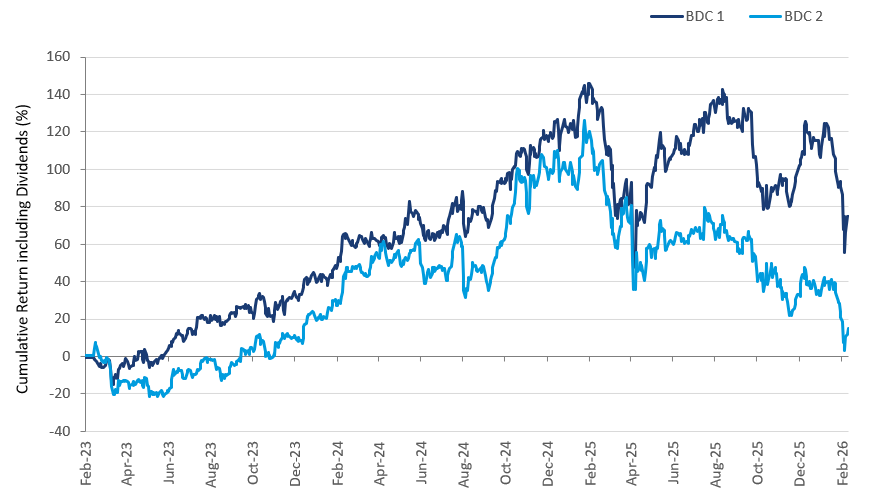
Perhaps most concerning for credit investors is the burgeoning industry disruption due to AI. While AI is a bull point for growth, it is a bear point for credit stability in disrupted sectors. Markets are beginning to price in the risk that legacy business models may become obsolete, potentially leading to sharp credit downgrades for companies that fail to adapt. The market is currently focused on software and business development companies (BDCs). BDCs have been large providers of financing to small and middle market companies, especially in the software space, since the pandemic. Disruption at the BDCs could have ripple effects on the broader economy and credit markets. The stock prices of two of the largest BDCs, have experienced significant weakness as of late (see chart below).
Given our belief that credit spreads remain well supported at current levels, but that bouts of volatility are likely as this cycle progresses, we are currently positioned with modest credit beta overweight, relative to the benchmark. We believe this positioning provides significant space to add risk if justified by risk premiums, while allowing us to capture positive carry if this environment persists. On a historical basis, our overweight position is quite conservative.
Business Development Company Equity Returns
Source: Loomis Sayles & Bloomberg. Used with permission from Bloomberg Finance L.P.
February 9, 2026
Important Disclosure
This marketing communication is provided for informational purposes only and should not be construed as investment advice. Any opinions or forecasts contained herein reflect the subjective judgments and assumptions of the authors only and do not necessarily reflect the views of Loomis, Sayles & Company, L.P. Investment recommendations may be inconsistent with these opinions. There is no assurance that developments will transpire as forecasted and actual results will be different. Data and analysis does not represent the actual or expected future performance of any investment product. Information, including that obtained from outside sources, is believed to be correct, but Loomis Sayles cannot guarantee its accuracy. This information is subject to change at any time without notice.
Market conditions are extremely fluid and change frequently.
Diversification does not ensure a profit or guarantee against a loss.
Any investment that has the possibility for profits also has the possibility of losses, including the loss of principal.
There is no guarantee that the investment objective will be realized or that the strategy will generate positive or excess return.
Past market experience is no guarantee of future results.
For Institutional Use Only. Not For Further Distribution
8768031.1.1
Meet the Author